Monday, December 14, 2015

Woodwork

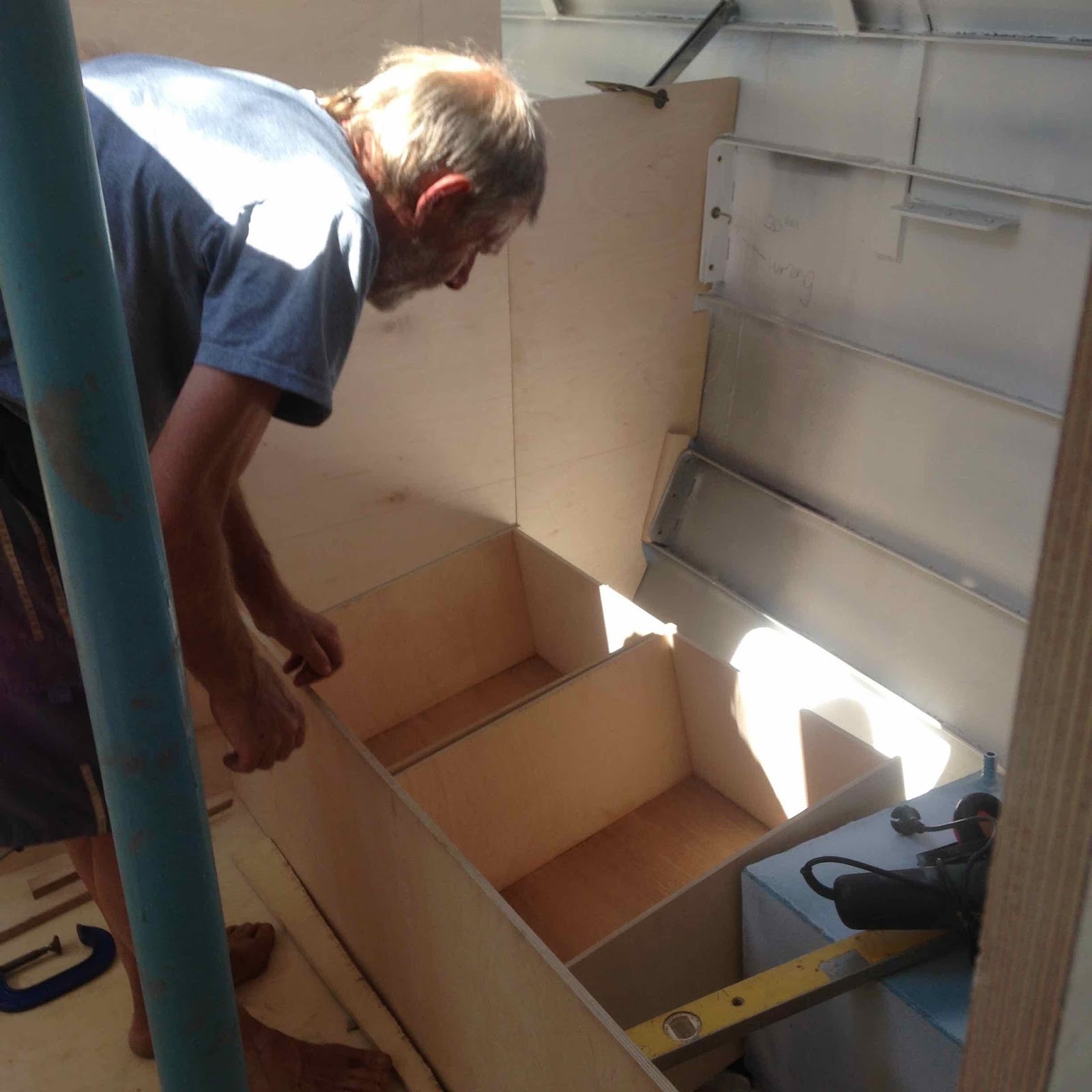
Progress  has been slow over the past two months. We have been feeling our way along, with many discussions and differences of opinion. At least there is some progress.

This was the easy one! And already rusted behind. 
Cutting into the keel. Yes, we should have done it before painting. 
David, Bongani and I have been concentrating on the hull, eliminating such rust traps as we could, to the point of cutting into one of the keels to get an offending bar out. I will explore coating systems to handle the hidden rust danger early in the new year.


Planning the salon.
Galley mockup. 


Fitting washboards.
Dave has been working on the bulkheads, making a mockup of the galley area, and working out the interior details.

Monday, November 9, 2015

A second voyage


Main mast
Our time at the Profection factory has drawn to an end. One of the last jobs they did for me was to weld up the mast, all 8.3 meters of it, and fix the mast foot and cap. Excellent work as usual. I cannot say enough of the kindness, support and encouragement I had from everybody, even when I asked for small one-off jobs in the midst of large production runs. Thanks, guys! I promise, when I look at Cape Horn and all goes well, I will remember your work.

Then we towed Dreamtine some 60 kilometers east, to Dave's farm, where the woodwork will be done. Again I had assistance from Reinhard, my daughter Hester and grandson Diederik, while Shahnaz looked in between showing her relatives around nearby Cullinnan.

Granddaughter Mieke came to inspect and pronounced
this a happy ship. 

While Dave works on the jigsaw puzzle, I had David and Bongani help eliminate the last rust trap we could eliminate, a construction flange in one keel. Appropriate language helped. Now we have to do the last of the preventative painting, get the hatches working, the hinges in where necessary, and then it is over to Dave.


Grandson Diederick checked the tie-downs

...and handled the communications.


Lieb provided his truck. Thanks!

Rust trap behind chainplates. Injected corrosion retardation product may help

Flange in the starboard keel came out with the help of bad language. Now to clean up and paint. 

Monday, September 21, 2015

A butterfly emerges ...

Trevor sanding the filler.
And at last the rusty hulk that had become a battleship grey submarine becomes a pristine white beauty. Well, almost. 

Teamwork conquers all: Merven and Francois sanding
We are dodging forecasts of rain, badly needed in the reigning drought, but still a problem in our painting program. And a short side trip to Cape Town took an important week out of our dry weather, but made up in good foor and wine. 

Is that going to be a submarine? Well, no longer!
The transformation begins.
So three guys from a shelter for homeless people came to help me 'flat' the hull, which means sanding it until it is a matt finish, which is good 'tooth' for the final coat of paint. And we discovered that the Carboguard undercoat is amazingly hard, so hard it blunts the sandpaper within minutes. 

I also took the angle grinder to the offending filler, and re-filled, but very frugally this time. Still a few small blemishes, but we are getting there. 

Then the girl at the paint place suggested we thin the 2K paint to 30 %, which made it much too thin, so we have a number of runs. And some water in the air line did not help, neither did the new spray gun: someone said we should turn the metering needle out, Eric demonstrated that it should be all the way in with the thin paint. The gun should be held away from the work, no, near the work... The learning curve continues. 

Adding a few extra microns where it is needed
Well, this week we should have time to flat it again, spray polyurethane on the decks, a second coat of epoxy on the hull, and make some progress with the mast step and other fittings. 

My thanks to David and Bongani who helped over weekends and did the major painting, Eric from Profection who showed us how it should be done. Merven, Koketso, Robert and Francois helped sanding, Prince cleaned and washed, Trevor sanded and advised. 


David admiring his handiwork.
As the Terminator said: I'll be back!


Saturday, August 22, 2015

Still painting

More than a month has passed since my last post, and all we have been doing is painting, repainting the paint, sanding, filling pinholes, filling dents and blemishes, sanding, sanding, sanding, sanding.

Adam, on his way to the airport, helped to
paint the tanks. Love the hair!
Some problems: The first spraypainting missed a number of critical spots, especially in places where the rust would strike. Some of these: the seam alongside the double hull, also behind stringers and under decks. Another problem: In a number of places there was still sand from the sandblasting when the painter struck. Which either cemented the sand and paint to the hull, or left the paint on top of a layer of dust and sand.

Trevor, sanding. 
Another problem is that, not far from where I work, there is a galvanising plant, and the smoke from the factory drifts over where I work. So the inside paint had a layer of what looks like dust ingrained in it.

Major sanding, in some cases grinding, was needed to get the damaged paint out. The epoxy paint  is incredibly hard, even an angle grinder was employed, and in a number of cases we went through the paint into the metal.
Alexander showing Molly the correct masking
technique. Gulliver helps.

We mixed epoxy filler and attacked all the irregularities on the hull, thereby creating another problem. Sanding the filler out clogs up sandpaper in seconds. I hope I get done before someone starts buying all the sandpaper on the market!

A number of friends came to help. Adam from Durban helped paint the tanks, and almost turned into a smurf. I got a lecture.

Alexander, an aircraft technician, helped with the spraying, but confided in me: She is never going to fly!
Bongani installing rivnuts

Reinhard helped, so did Trevor, and David and Bongani helped every Saturday and even one holiday. David did a few welding jobs we discovered, Bongani installed more than a hundred rivnuts.

Huan brought Molly and Gulliver: Two very polite kids who helped a lot.

Thanks, all of you!


Tuesday, July 7, 2015

End of the first phase, now the next phase begins

The blasting begins!
We survived the sandblasting and painting. As Dough says: I have learnt so much from my mistakes, I plan to make some more. The steel boat gurus say you should not sandblast more than you can paint the same day. The painters and others say steel does not rust so fast. Well, it does. I had hoped to do the sandblasting and painting in May, the driest month in Pretoria, but one thing and the other delayed us till end of June, a period where fog and early morning frost or dew is a real possibility.

We decided to sandblast inside, and then spray it. Then we would sandblast the outside and spray that. Of course the blasting outside would damage some of the paint inside. As a sop to my paranoia about rust it was conceded to blast the loose parts like tanks and window frames on the last day of blasting, so the painting could begin immediately.

Hard, dirty work. There has to be a better way. 
I had decided to use Carboguard 550 epoxy primer in two colours: blue over the blasted steel so it is easier to see what areas were missed, then a second coat of gray to build up to the required thickness.

The first problem was that, once we had blasted the outside, rust spots appeared overnight, requiring a second brush blast. And the loose parts picked up damp from the floor they were laid on, showing rust within hours, again requiring a second blast. Secondly the blasting opened up pinholes and porous welds, at a time where re-welding was just not possible. Thirdly we did not realise how difficult it would be to remove the spent grit from inside. The contractor eventually gave in and rented an industrial vacuun cleaner, which did the job in minutes.

Rust spots on the rudder within hours. Damp floor is the cause
Luck was with us: the 5% chance of rain did not materialise. Then problems with the airless spray machine caused it to spray a thick first coat, in effect two coats at the same time. Which meant that the inside of the boat and most of the loose parts are now blue, the rest is gray.

Outside blasting did not cause much damage to the inside paint as far as we could see, but I will do a minute inspection once we are in full sunlight.

Next time I build a boat (Wife having hysterics in the background) I will decide on the paint system before beginning to build. All steel will be blasted at a proper sandblasting plant and coated with a  welding primer. Then, as the work proceeds, it will be wire-brushed and re-primed.

And I will not have freshly painted parts nearby when someone brushes grit off the hull....

Pinholes and porosity. 
The idea of building upside down so the grit from blasting inside would fall out has much to recommend it. So too Colvin's idea of leaving the keel plates off, so grit can be shovelled out there. Buckets of grit weigh a lot!

Now what remains is a few spots of remedial painting and cleaning up the site, then begins the woodwork. A lot of new mistakes to make...


And the primer goes on. 

Monday, June 29, 2015

It feels like going down the rapids

My assistant, Prince, had fun with the Karcher, spreading degreaser
I rafted the Owen falls rapids in Uganda three times. That is enough to have you certified. The major rapid is called Silverback, and you have the whole Nile river going through about 30 meters of channel. It looks awesome from the top, and there is really no way to chicken out and walk back. And when you start going down, there is a moment, as the stream begins to take you and the river makes a hump before you, when you wonder if this was a good idea.

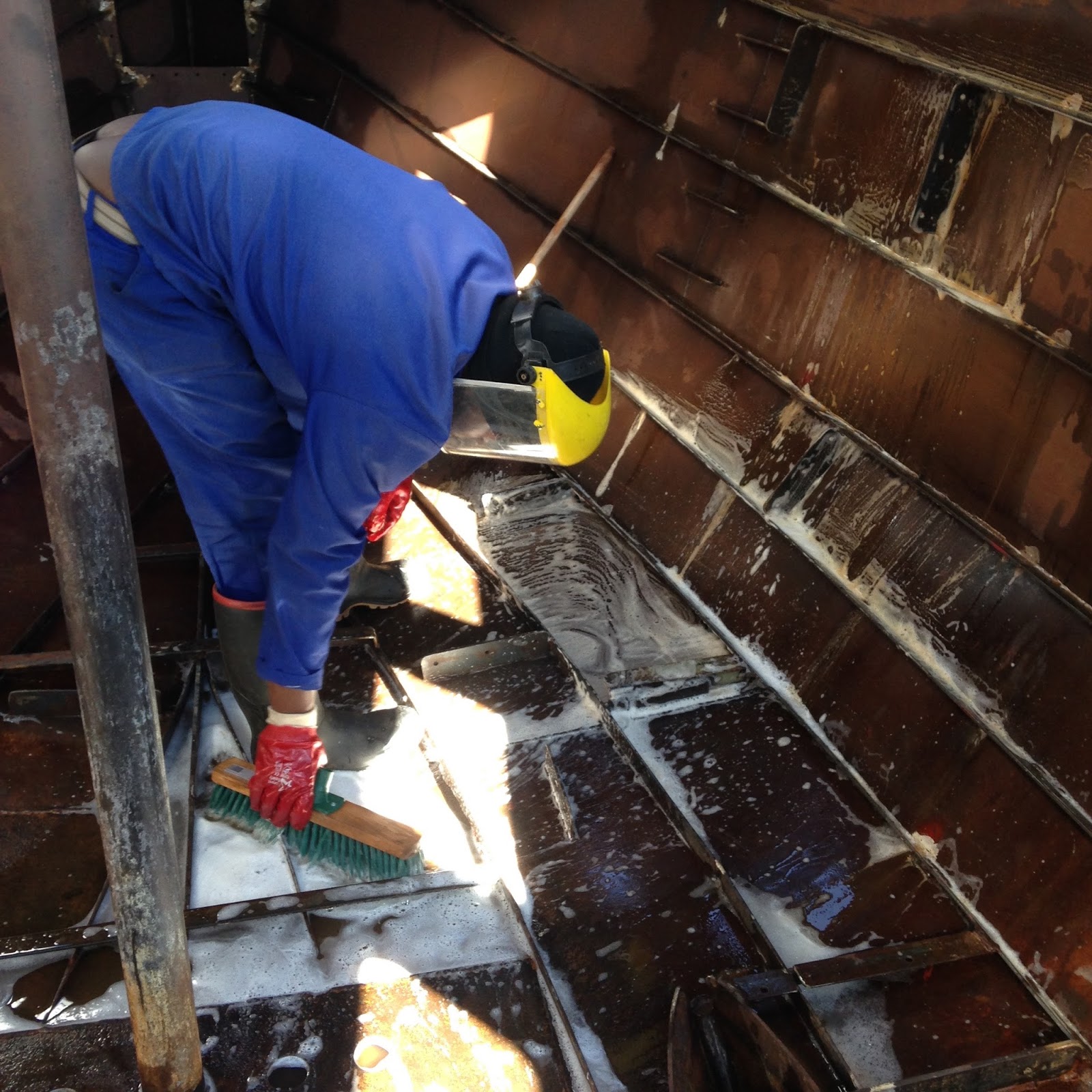
The work on Dreamtime is at a similar point. We did a major degreasing today, washing the whole hull about four times, partly because I tripped over the bucket just when we had washed out most of the degreaser, and spilled a whole lot of fresh, expensive degreaser back into the hull, so we had to wash that out again.

And scrubbing the interior. 
Tomorrow morning I have to get up early to collect the compressor and fill it and the jerry can with diesel. The sandblaster and the spray painter will be there around nine, and then we start.

Once sandblasted we have only a few hours grace before we have to have the paint on. Now, the first problem is: Sandblasting should take about three days. Do we interrupt the blasting and paint when half is done, and risk damaging the primer with the next lot of blasting? Do we trust that the rust will give us time?

One power cord. Two hosepipes to drain the water, one to put fresh water in.
Result: one almighty tangle. They say it has to do with string theory.
Pretoria has beautiful sandblasting weather in May. Cold, dry, clear. But we were not ready. In fact we should have been ready last year in May, but things got complicated. Last weekend we had a cold front move through, which brought some moisture. Fog in the mornings, especially the low lying areas. This morning the hull was wet, even under the old swimming pool cover I have over her. So, no possibility of waiting overnight.

And I have only half the paint I ordered. Which should be OK for the first coat, but... It was promised for tomorrow. Insh'Allah.


Saturday, June 6, 2015

Are we ready yet?

Something is dripping ...
And another three weeks have gone. Weeks of grinding drainage holes: Mark Twain told of a steamboat that was like a politician: the whistle used more steam than the boiler could supply so when the whistle blew the boat stopped, like a politician who, when his mouth opened his brain stopped. Well, I have a political die grinder. It works like a charm, for two minutes, then the little compressor has to run for five minutes to catch up. So imagine, if you will, me grinding away for two minutes, then I climb down the ladder to drill holes, grind seams, or do whatever, The moment the compressor stops I am back up the ladder, grind for two minutes....

No, leaking!
The last bit of rewelding of seams had a story to them. Isaac called me to show that they could not weld the central seam, as there was water dripping out where Kenzo had ground it out.
Supports are rewarded

Awkward welding of a support under the side deck

Rudder fittings go on.
So I drilled a little hole.... The closed compartment where the mast support rests was not as closed as it should have been, and was full of rain water. I cut four 50mm holes in it in order to be able to see the hull, which is what I had asked for in the beginning.

I also drilled all the holes where rivnuts must go to 9mm, took out the waste and water tanks and drilled their mounting holes to 11mm for the 8mm rivnuts that will hold them. And today we had the last session of welding the rudder fittings on, and grinding the last sharp edges round. We did not quite finish that, so I have three days to do that when we are back from the coast.

Then the sandblasting and spray painting waits. A compressor is lined up, but I must do the paperwork and pay a deposit. The sandblaster is lined up and a deposit paid. The paint and degreaser is lined up and paid for, but I do not have a delivery date. Airless spray equipment is lined up, but must be checked. The most important element, though, is still missing: the spray painter. I have a name of someone highly recommended, who has worked at the factory before. They trust him on their equipment. But he does not answer his phone...

Thanks to David for helping with the welding, and Bongani for grinding miles of seams and rounding hundreds of corners!

And to the Profection team: Isaac, Kenzo, Lucas and Thomas.

Stay tuned...